PRIVACY POLICY
Greater Games develops games that can be used without hesitation by parents and caregivers for educational purposes.
Below, we list the data we collect to achieve the necessary quality levels while ensuring full data protection.
The data we collect is used to track how well our games achieve their core objectives: to be fun and to impart knowledge. At the same time, we make sure that children and families can enjoy our games without having to worry about their privacy and security.
This short document explains what kind of data is collected by the game “Uuugh – False Play,” what happens to it, what it is used for, and what control you have over it.
WE DO NOT COLLECT PERSONAL DATA
We do not collect any personal data (information that can be used to identify a specific person). We also do not share any of the data we collect with third parties.
In places where our servers, due to an unchangeable backend process, come into contact with personal data (specifically IP addresses), we automatically delete this data at the earliest possible opportunity.
The following table lists the moments when we come into contact with data that is somewhat adjacent to personal data. Each point is accompanied by an explanation of how these data points are handled:
| Where in the Game? | Which Data? | What happens with the Data? |
|---|---|---|
Options > Language  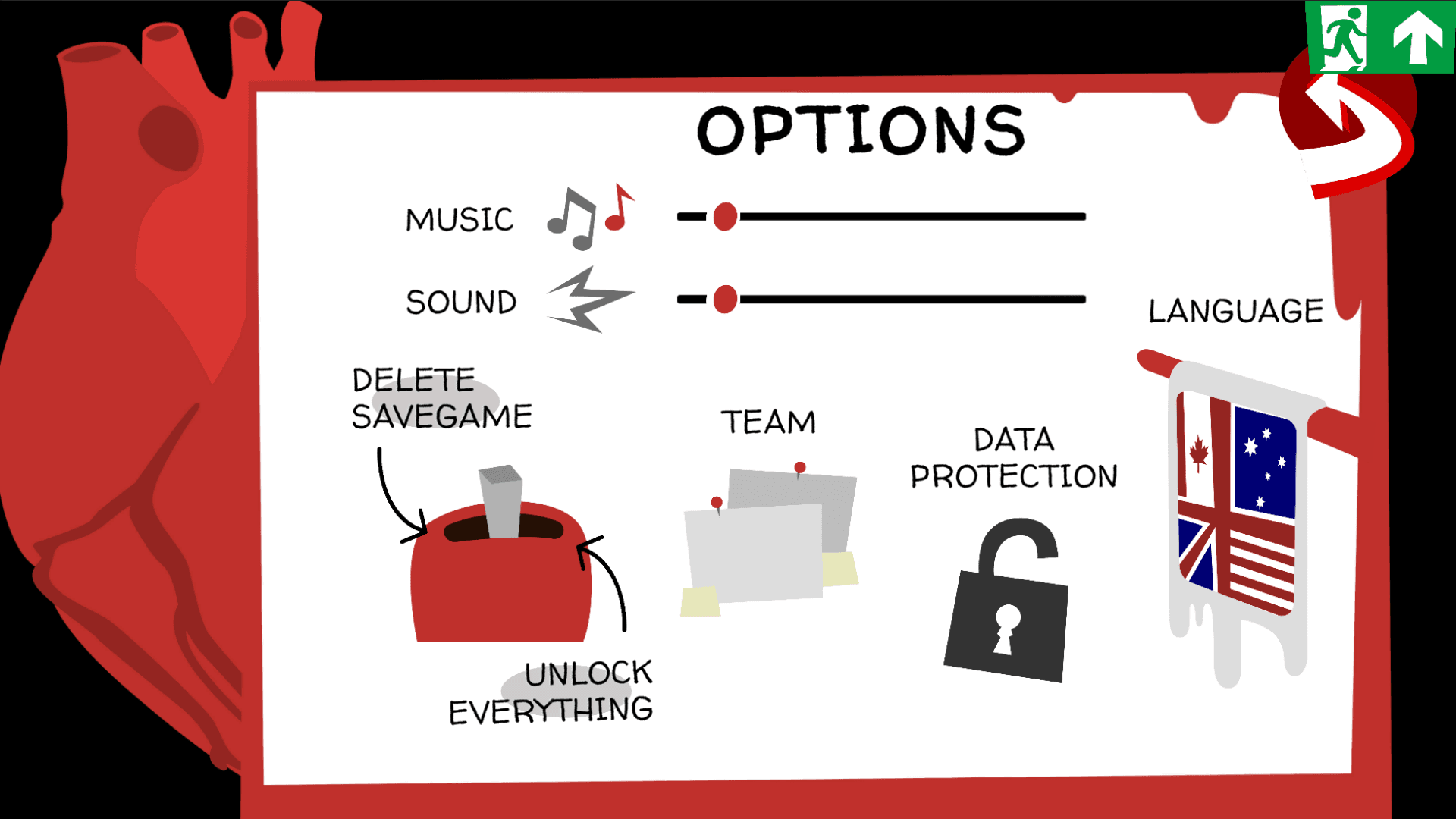 | Display language Players can change the language in which the game is displayed. This may (but does not have to) reflect the player's primary language. | Stored on the device The selection is saved on the device so that the game can be displayed in a language that the players understand. Collected The selected language is recorded as part of the game data. In conjunction with the other data we collect, it is not sufficient to identify players. |
Various situations in which game data is collected | IP Address When your device contacts our data collection server (or another server) on the Internet, your device's IP address is transmitted. | Not stored, not collected Our data collection servers forget IP addresses as quickly as technically possible. We only use the IP address to connect initially and collect anonymous data, but at no time to locate devices via their IP addresses. |
Below is a list of the data collected in the game, along with the respective purpose.
WE COLLECT DATA ABOUT USAGE OF THE GAME
Below, we first explain the specific process of data collection and then the content and reasons for the non-personal data we collect about players' activities in the game.
The data is transmitted from the user's device to a server operated by the company Hetzner (contractual relationship: order processing agreement; location: Germany (Nuremberg/Falkenstein)). This server runs software developed by us that receives and manages the data.
The data we collect includes:
- Time stamps: The times at which the actions listed below are performed.
Why: This shows how long users took to perform actions. This allows usability issues to be identified in the event of deviations from the expected time frames. - What actions were performed in the game (e.g., asking questions, influencing, giving instructions, observing, listening, waiting, and all related subcategories)
Why: This allows us to determine which actions are used more frequently and which are not discovered at all or were discovered but not used.
This enables us to focus more effectively on specific courses of action and the resulting strategies and their prevention for further scenarios. - Which scenes were viewed (e.g., introduction, main game, game win/game end)
Why: This allows us to measure how long players play. We can then determine whether certain points prove to be frequent drop-off points and adjust them accordingly. - Which screens were open (options, notebook, owl book, help screen)
Why: This allows us to determine how extensively specific elements of the game were used. The didactic elements in particular the perpetrator strategies in the notebook and the tips in the owl book are of interest here, as they allow us to estimate, together with the duration of viewing, not only how often but also how long the written learning content was engaged with. - Changing options (volume, language, delete/unlock game score)
Why: This allows us to determine whether our default settings are appropriate. For example, if users frequently readjust the music volume, we can adjust this value globally for everyone, making the gaming experience smoother. - Number of moves per sub-scenario
Why: This allows us to check whether certain sub-scenarios are more difficult to manage than others. We can then make appropriate adjustments to make the individual intermediate steps through the scenarios more fluid. - Final data points at the end of a scenario (how many friends, how many actions, how many days)
Why: This allows us to compare how long different players take to complete the scenarios. We can use the average value calculated in this way for comparison when building future scenarios. - Technical information about the device used by the player: operating system and version.
Why: This information allows us to determine whether certain errors occur for everyone or are specific to a particular device type or operating system.
The collected data is only processed internally by us (Greater Games) to understand the players' experience in the game and to improve the game accordingly based on the impressions gained from the data. We do not share it with anyone else. As listed above, some of the data points are aggregated or linked together—primarily times, durations, and actions—from which we will create aggregated statistics for specific questions (e.g., “X% of players have completed the game”).
We share such data with our institutional partners (working group “Knowledge Transfer, Dissemination, E-Learning of the Clinic for Child and Adolescent Psychiatry, Psychosomatics, and Psychotherapy” at Ulm University Hospital and the German Federal Ministry of Education, Family, Seniors, Women, and Youth). In addition to the opportunities for improvement, this is also important for determining whether the game as such or such games in general should be (further) developed in the future.
All collected data is pseudonymized: it is linked by an application ID, which is generated when the game is first launched after installation. Unlike more sensitive and personal types of identifiers (IDs), such as device IDs, cookie IDs, or hardware IDs, our identifier is specific to the game and cannot be used to track players in other apps or websites.
The ID is also deleted after uninstallation (unlike the device ID provided by the device, which we do not use for this very reason).
NO THIRD PARTY COLLECTS DATA
The game was developed using Unity, a game engine that requires access to certain technical information about the player's device in order to function properly: device manufacturer, hardware components, device and network identifiers, user language, etc. To the best of our knowledge, we have disabled all data collection by Unity that could potentially occur. Our tests have shown that Unity or other third parties do not send any data from our game over the Internet, including the technical information mentioned above.
You can also read Unity's privacy policy (section “I play a game developed with Unity software or using certain Unity software, what should I know?”) for further details.
YOU HAVE CONTROL OVER YOUR DATA
We give our players full control over data collection.
During gameplay, you can disable data collection at any time or even request the deletion of all data we have ever collected from your device.
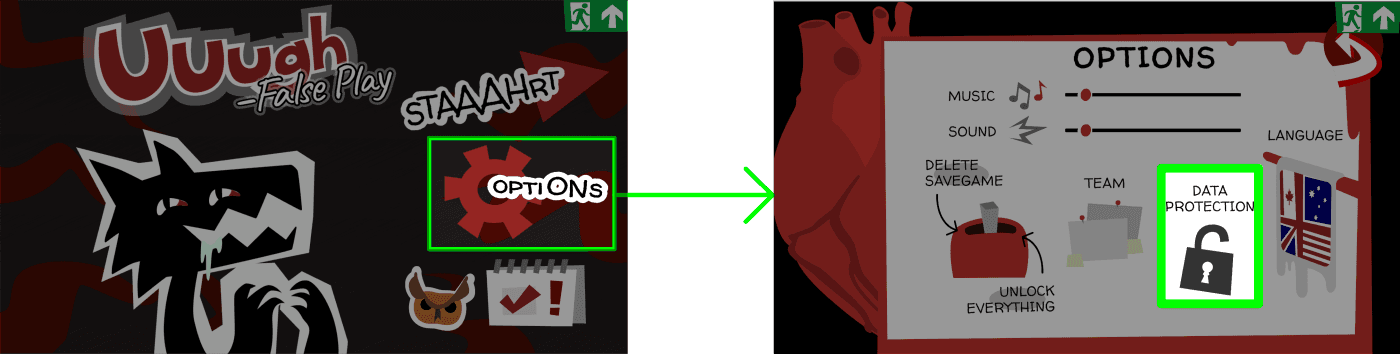
To do so, simply start the game and go to the “Options” button from the main menu.
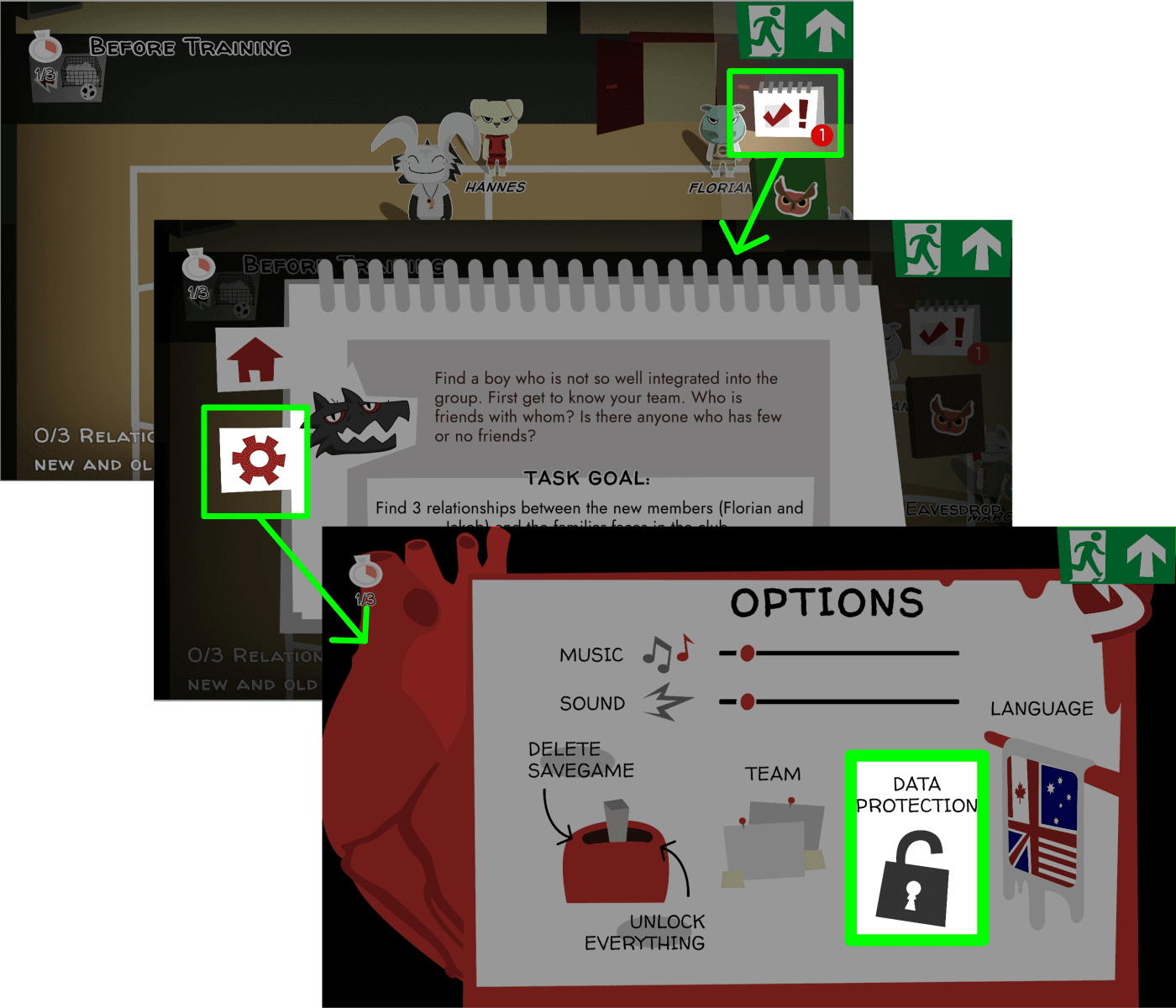
To access the menu when you are already in the game, go to the notebook. There you will find the button for the options menu on the left. Tap on the Privacy button there.
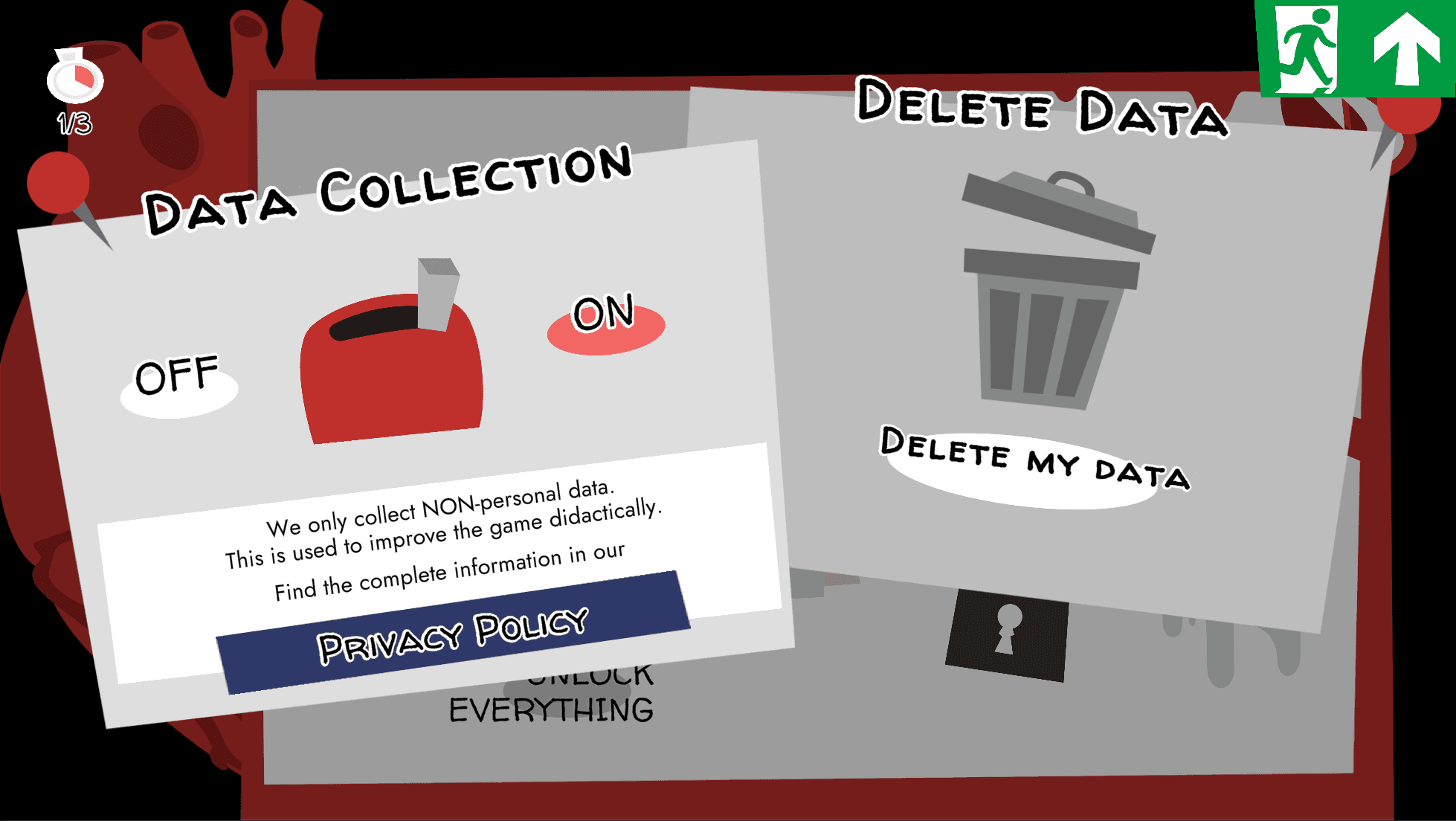
On this screen, you can tap the “Data Collection” button on the left to turn off data collection. When it is turned off, the button will display a cross instead of a check mark.
You can also request the deletion of your data by tapping the trash can “Delete My Data” on the right and then following the instructions. Your device must be connected to the internet. After requesting deletion in the game, it may take up to two weeks for the data to be completely deleted, as it is deleted directly from the server but remains in the backups for up to two weeks until they are automatically overwritten.
It is only possible to request the deletion of your data as long as the game is installed on your device. Since we do not collect any personal data, we cannot associate the data we collect with a device or a person. The game remembers on your device which data it has sent and can therefore automatically request its deletion, but this information is lost when the game is uninstalled.
SUMMARY
Data Controllers and Processors & Legal Notice
Greater Games, Inh. Prof. Dr. Greta Hoffmann
Westmarkstr. 24, D-76227 Karlsruhe
+49 176 43878634
greta@greatergames.net
Data Collection
No personal data is collected.
The following table summarizes all data collected.
| What Data? | Who collects the Data? | What are they used for? |
|---|---|---|
Game usage | Greater Games | Analysis & UX analysis to improve the educational impact of the game. Anonymous summaries to report usage to our partners. |
Operating system and version of the device | Greater Games | Analysis & UX analysis to improve the educational impact of the game. Anonymous summaries to report usage to our partners. |
Selected language | Greater Games | Analysis & UX analysis to improve the educational impact of the game. Anonymous summaries to report usage to our partners. |